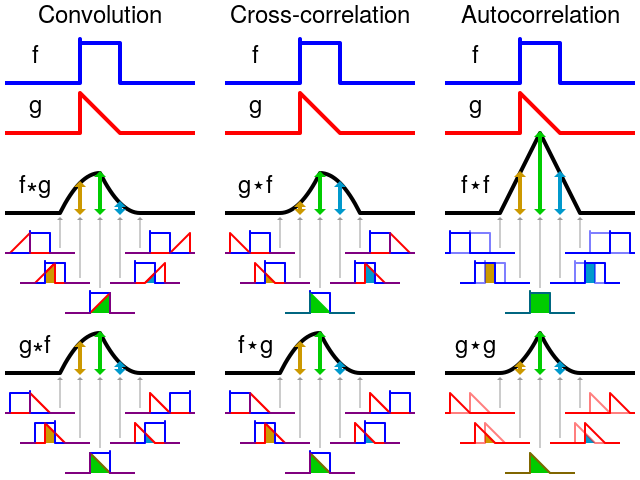
Para entender con más detalle la
Figura 2.3.4, consideramos el pulso rectangular
\begin{equation*}
x(t)
\ = \
\begin{cases}
1 & \text{ si } 0\le t\le 1 \\
0 & \text{para los demás valores de } t
\end{cases},
\end{equation*}
y el pulso triangular
\begin{equation*}
y(t)
\ = \
\begin{cases}
1-t & \text{ si } 0\le t\le 1 \\
0 & \text{para los demás valores de } t
\end{cases}.
\end{equation*}
La convolución de \(x(t)\) e \(y(t)\) es
\begin{align*}
(x\star y)(t)
& =
\int_\RR x(\xi)y(t-\xi)\dd \xi\\
&=
\int_{-\infty}^\infty
\left(
\begin{cases}
1 & \text{ si } \xi\in [0,1] \\
0 & \text{ si } \xi\notin [0,1]
\end{cases}
\right)
\left(
\begin{cases}
1-t+\xi & \text{ si } t-\xi \in [0,1] \\
0 & \text{ si } t-\xi \notin [0,1]
\end{cases}
\right)
\dd\xi.
\end{align*}
Para simplificar esta integral, trabajamos primero el segundo factor. Como
\begin{align*}
t-\xi
& \ \in\ [0,1]\\
\ \iff \
\xi - t
& \ \in \ [-1,0]\\
\ \iff \
\xi
&\ \in \ t + [-1,0]
\ = \
[t-1,t]
,
\end{align*}
tenemos
\begin{equation*}
(x\star y)(t)
\ = \
\int_{-\infty}^\infty
\left(
\begin{cases}
1 & \text{ si } \xi\in [0,1] \\
0 & \text{ si } \xi\notin [0,1]
\end{cases}
\right)
\left(
\begin{cases}
1-t+\xi & \text{ si } \xi \in [t-1,t] \\
0 & \text{ si } \xi \notin [t-1,t]
\end{cases}
\right)
\dd\xi.
\end{equation*}
El primer factor se anula si \(\xi\notin[0,1]\text{,}\) y el segundo si \(\xi\notin[t-1,t]\text{.}\)
Por tanto,
\begin{align*}
(x\star y)(t)
& =
\begin{cases}
\int_0^t
1\cdot (1-t+\xi) \dd \xi
&
\text{ si } t\in[0,1],
\\
\int_{t-1}^1
1\cdot (1-t+\xi) \dd \xi
&
\text{ si } t\in[1,2]
\end{cases}\\
&=
\begin{cases}
\left.
(1-t)\xi + \tfrac12 \xi^2
\right|_{\xi=0}^{\xi=t}
&
\text{ si } t\in[0,1],
\\
\left.
(1-t)\xi + \tfrac12 \xi^2
\right|_{\xi=t-1}^{\xi=1}
&
\text{ si } t\in[1,2]
\end{cases}\\
&=
\begin{cases}
(1-t)t + \tfrac12 t^2
&
\text{ si } t\in[0,1],
\\
(1-t) + \tfrac12 - (1-t)(t-1) - \tfrac12 (t-1)^2
&
\text{ si } t\in[1,2]
\end{cases}\\
&=
\begin{cases}
t-\tfrac12 t^2
&
\text{ si } t\in[0,1],
\\
\tfrac32 - t + \tfrac12 (t-1)^2
&
\text{ si } t\in[1,2].
\end{cases}
\end{align*}
En la primera columna de
Figura 2.3.4 podemos ver una representación gráfica de esta función. Comprobamos que, efectivamente,
\((x\star y)(0) = (x\star y)(2) = 0\) y
\((x\star y)(1)=\tfrac12\text{.}\)