Largest Known (Degree, Diameter)-Graphs
Diameter 3
Last modification: October 6, 2026; April 13, 2025. -- added adjacency lists for entries (9,3), (10,3), (11,3), (12,3), (14,3), (15,3), and (16.3), provided by V. Pelekhaty --
https://web.mat.upc.edu/francesc.comellas/old-files/delta-d/taula_delta_d.html
raw adjacency list format: the first vertex of each row is adjacent to all the other vertices in that row.
implicit adjacency list format: each row corresponds to a vertex (row 1, vertex 0; row 2, vertex 1; and so on) and contains all vertices adjacent to it.
adjacency list NX NetworkX format. NetworkX format.
semidirect product Follows the notation of the original contributions from Dinneen and Hafner (arXiv preprint) Networks, 24 (1994) 359-367: Zm ⋉a Zn,
of order m·n. Group operation defined as [x,y] × [u,v] = [(x+u) mod m, (y·au+v) mod n]].
C5xF4
Degree = 3, Diameter = 3; Order=20; Moore bound=22;
optimal
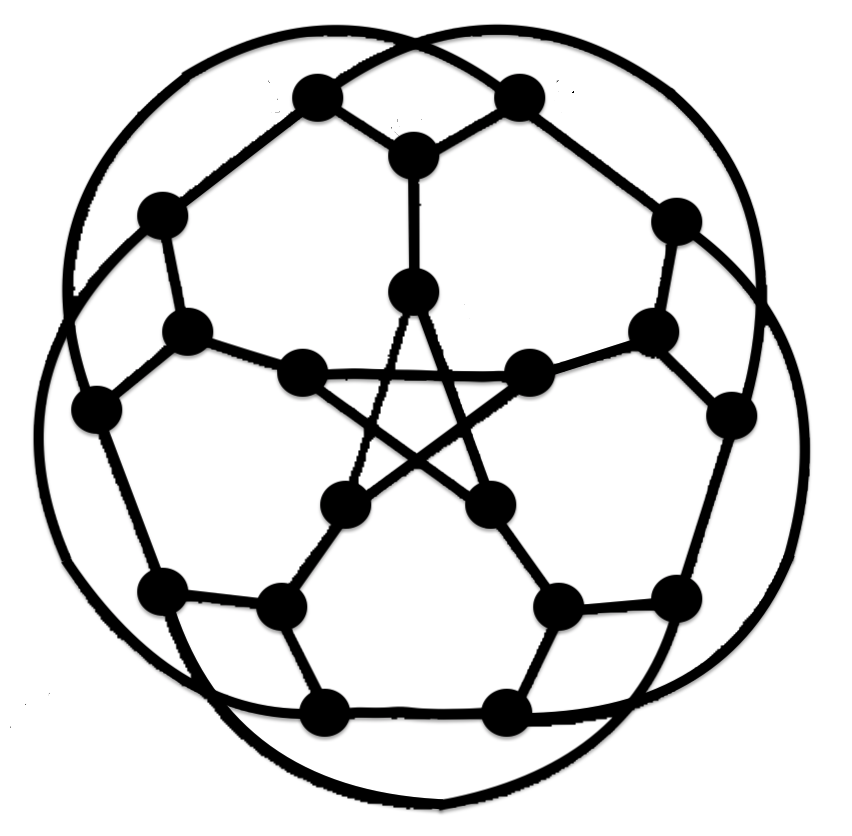
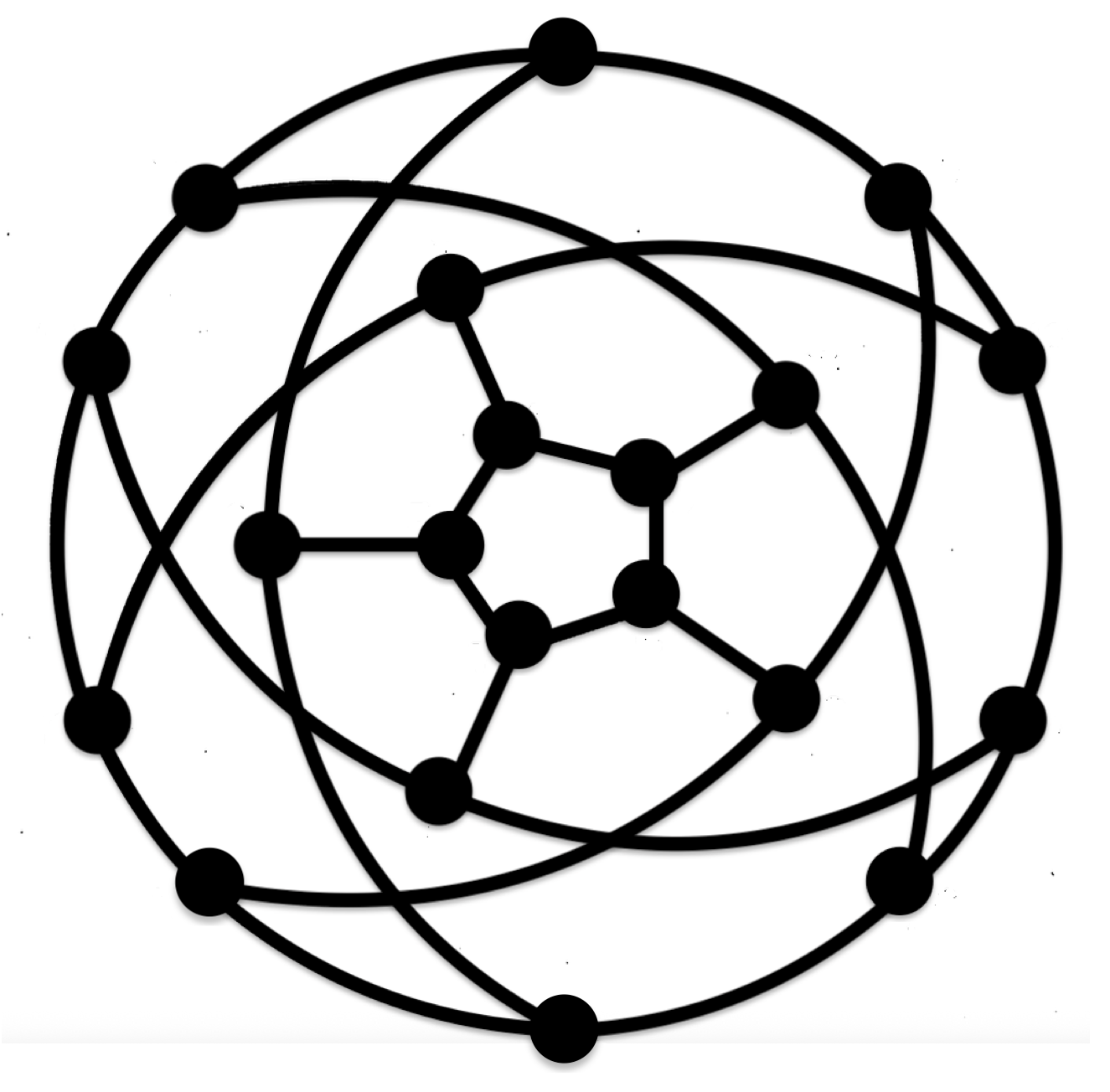 B. Elpass. Topological constraints on interconnection-limited logic. 1964 Proceedings of the Fifth Annual Symposium on Switching Circuit Theory and Logical Design, Princeton, NJ, USA, 1964, pp. 133-137.
doi:10.1109/SWCT.1964.27
A detailed description: I. Alegre, M.A. Fiol and J.L.A Yebra; Some large graphs with given degree and diameter; J. Graph Theory,10 (1986), pp.219-224. doi:10.1002/jgt.3190100211
Download the NX adjacency list of C5xF4. Download the implicit adjacency list of C5xF4.
This SageMath script computes several properties of the graphs including symmetry group sizes and the number of k-cycles (k=3..10). This is the online version .
B. Elpass. Topological constraints on interconnection-limited logic. 1964 Proceedings of the Fifth Annual Symposium on Switching Circuit Theory and Logical Design, Princeton, NJ, USA, 1964, pp. 133-137.
doi:10.1109/SWCT.1964.27
A detailed description: I. Alegre, M.A. Fiol and J.L.A Yebra; Some large graphs with given degree and diameter; J. Graph Theory,10 (1986), pp.219-224. doi:10.1002/jgt.3190100211
Download the NX adjacency list of C5xF4. Download the implicit adjacency list of C5xF4.
This SageMath script computes several properties of the graphs including symmetry group sizes and the number of k-cycles (k=3..10). This is the online version .
Allwr
Degree = 4, Diameter = 3; Order =41; Moore bound=53;
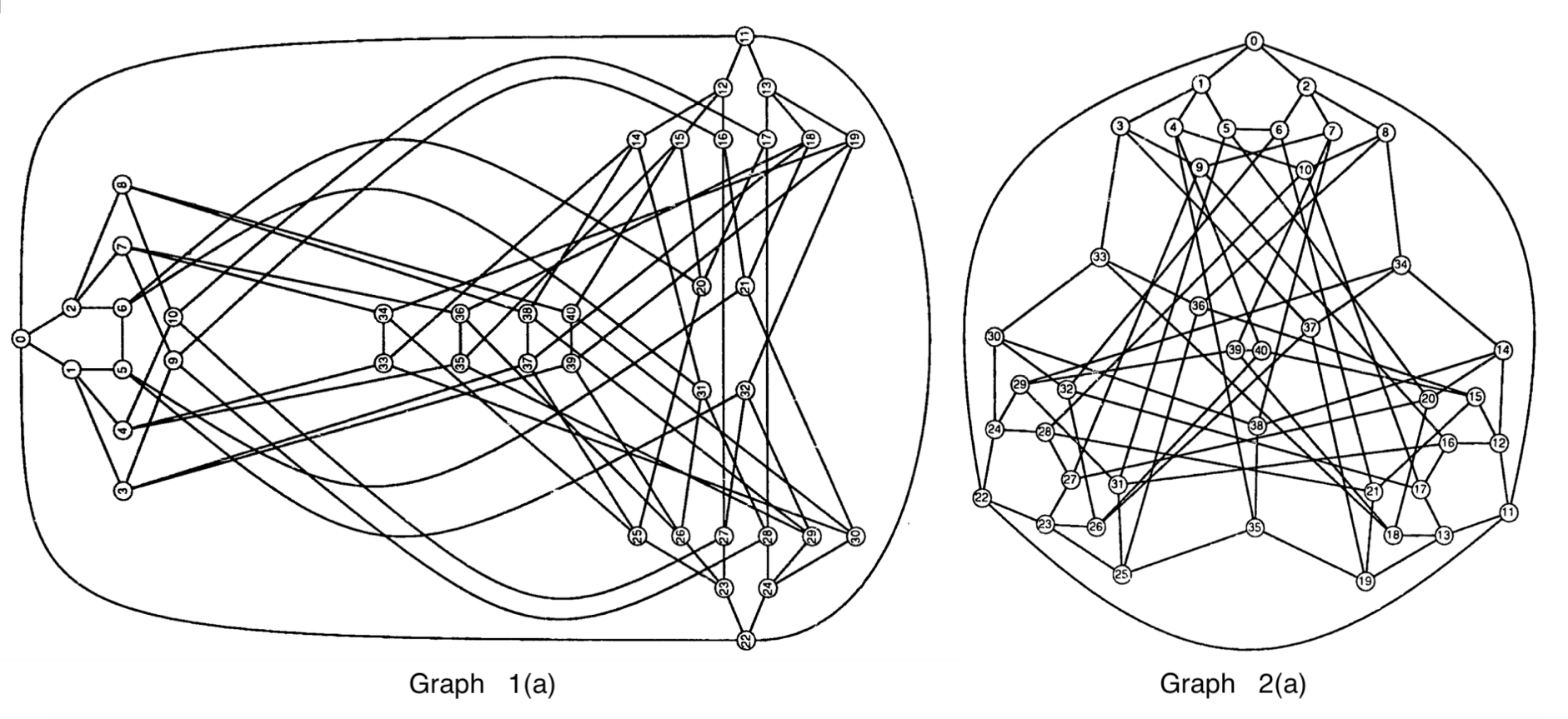
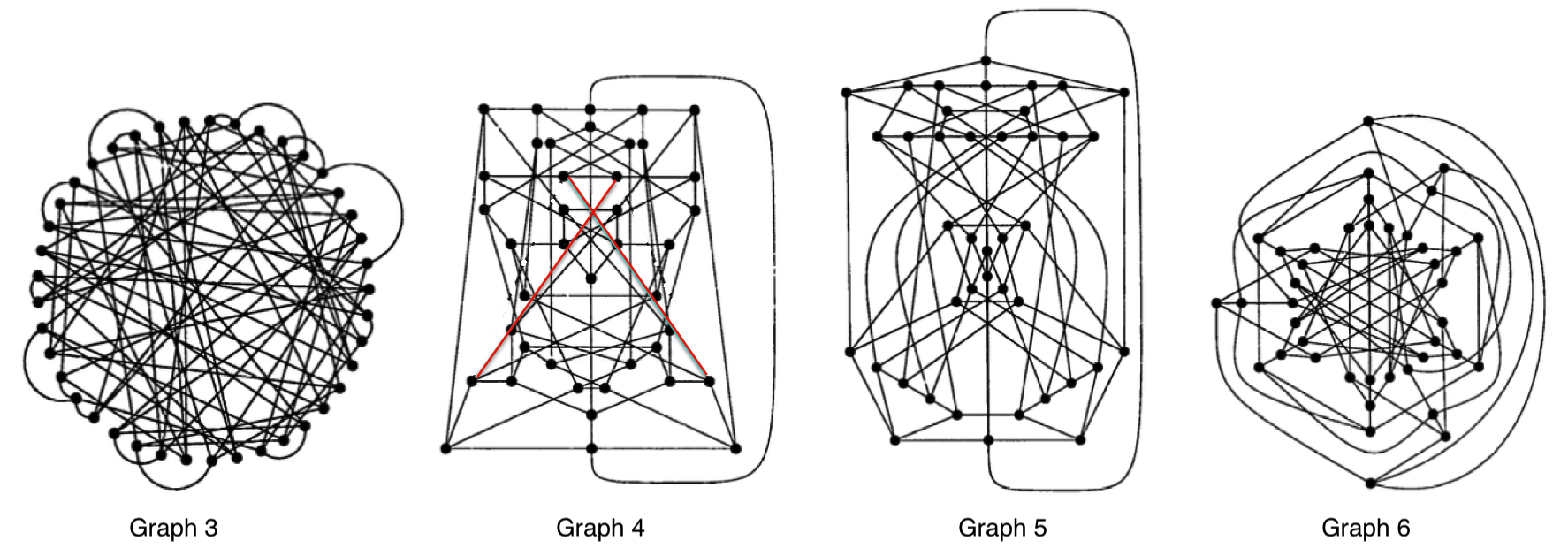 Graphs found by
James Allwright
(School of Computer Science, University of Westminster) by using a
heuristic
algorithm.
13 non isomorphic graphs with 41 vertices were found.
J. Allwright, New (Delta, D) graphs discovered by heuristic search. Discrete Applied Mathematics , 37/38 (1992), pp. 3--8.
Adjacency list NX of Graph 1(a).
Adjacency list NX of Graph 1(b). Obtained from 1(a) by the 2-swap [(25,34),(30,33) to (25,33),(30,34)].
Adjacency list NX of Graph 1(c) . Obtained from 1(b) by the 2-swap [(31,6), (32,5) to (31,5), (32,6)].
Adjacency list NX of Graph 1(d) . Obtained from 1(c) by the 2-swap [(17,20), (28,31) to (17,31), (28,20)].
Adjacency list NX of Graph 1(e) . Obtained from 1(d) by the 2-swap [(16,21), (27,32) to (16,32), (27,21)].
Adjacency list NX of Graph 1(f) . Obtained from 1(e) by the 2-swap [(14,33), (19,34) to (14,34), (19,33)].
Graphs found by
James Allwright
(School of Computer Science, University of Westminster) by using a
heuristic
algorithm.
13 non isomorphic graphs with 41 vertices were found.
J. Allwright, New (Delta, D) graphs discovered by heuristic search. Discrete Applied Mathematics , 37/38 (1992), pp. 3--8.
Adjacency list NX of Graph 1(a).
Adjacency list NX of Graph 1(b). Obtained from 1(a) by the 2-swap [(25,34),(30,33) to (25,33),(30,34)].
Adjacency list NX of Graph 1(c) . Obtained from 1(b) by the 2-swap [(31,6), (32,5) to (31,5), (32,6)].
Adjacency list NX of Graph 1(d) . Obtained from 1(c) by the 2-swap [(17,20), (28,31) to (17,31), (28,20)].
Adjacency list NX of Graph 1(e) . Obtained from 1(d) by the 2-swap [(16,21), (27,32) to (16,32), (27,21)].
Adjacency list NX of Graph 1(f) . Obtained from 1(e) by the 2-swap [(14,33), (19,34) to (14,34), (19,33)].
Adjacency list NX of Graph 2(a) .
Adjacency list NX of Graph 2(b) . Obtained from 2(a) by the 2-swap [(4,35), (7,38) to (4,38), (7,35)].
Adjacency list NX of Graph 2(c) . Obtained from 2(b) by the 2-swap [(16,31), (17,32) to (16,32), (17,31)].
Adjacency list NX of Graph 3 .
Adjacency list NX of Graph 4 .
Adjacency list NX of Graph 5 .
Adjacency list NX of Graph 6 .
Graphs 1(a) to 1(f) all share the same average distance of 2.5036585.
Graphs 3, 4, 5 and 6 have an average distance of 2.5.
I corrected Graph 4 from the Fig. 3 of Allwright's paper, as it initially produced a graph with a diameter of 4. If we label the vertices of Graph 4 from Fig. 3 of the paper from left to right and top to bottom (starting with 1), we need to swap the edges (12, 32) and (13, 37) to obtain the intended graph, which gives the correct values for the diameter and the number of k-cycles in the paper. In the above figure, I have removed the wrong edges and added (in red) the correct ones.
Three additional graphs with 41 vertices, maximum degree 4 and diameter 3 were obtained by Michel de Messieres (October 2026). They are denoted N1, N2, and N3. The first two are triangle-free (girth 5); N3 has exactly one triangle (girth 3). All three have 82 edges.
Adjacency list NX of Graph N1 .
Adjacency list NX of Graph N2 .
Adjacency list NX of Graph N3 .
This SageMath script computes several properties of the graphs including symmetry group sizes and the number of k-cycles (k=3..10). This is the online version .
Note that a few values computed by this script with respect symmetry group sizes do not match those reported in the paper. I have verified these results with Mathematica and I believe they are correct. Also the value of the number of 10-cycles for Graph 1(b) is 2686 and not 2666 as stated in the paper (likely a misprint, thanks to M. de Messieres for noticing it).
Exoo_72
Degree = 5, Diameter = 3; Order =72; Moore bound=106;
Communicated by G. Exoo (May 22, 1998). G.E. data
Download the implicit adjacency list of the graph.
Download the adjacency list NX of the graph.
Geoffrey Exoo. A family of graphs and the degree/diameter problem. J. Graph Theory 37 (2001), 118-124.
This SageMath script computes several properties of the graphs including symmetry group sizes and the number of k-cycles (k=3..10). This is the online version .
Michel_120
Degree = 6, Diameter = 3; Order =120; Moore bound=187;
https://sagecell.sagemath.org/?q=vnrnva
Obtained by Michel de Messieres (michel@demessieres.com, October 4, 2026).
The search programs were written and run by an AI assistant (Anthropic's Claude) under the author's direction.
This graph is the lift of a voltage graph with 2 vertices over the group SmallGroup(60,9) = C5 x A4 (so 2 x 60 = 120 vertices). Each of the two vertex types has one semi-edge (its voltage is an involution, giving a perfect matching inside the type) and five edges to the other type. Its automorphism group has order 60 with two orbits of 60 vertices, so it is not vertex--transitive. This construction is not derived from the 119-vertex graph (whose automorphism group has order 672 and three orbits).
It was found by a computer search over (number of base vertices) x (all groups of the given order, from GAP's SmallGroups library) x (orders just above the record), optimising the voltages by simulated annealing until every pair of vertices was within distance 3.
The graph and a detailed write-up are also on Zenodo https://doi.org/10.5281/zenodo.23136968
Download the edge list of the graph.
This SageMath script computes several properties of the graphs. This is the online version .
Former result, order 119.
Obtained by Rishabh Rajiv (rishabh.rajiv@alumni.ubc.ca, Septembert 24, 2026) with the use of AI agentic coding systems. Orbit graph from G = PGL(2,7), of order 336, with orbits V1, V2, V3 of sizes 14,21,84
and stabilizers of orders 24,16, 4.
In this link:
https://doi.org/10.5281/zenodo.22928337
you can download the edge list, and a paper describing the details of the construction of the graph.
Download the local edge list of the graph.
This SageMath script computes several properties of the graphs including symmetry group sizes and the number of k-cycles (k=3.). This is the online version .
Former result, order 111.
Communicated by G. Exoo (May 19, 2010). G.E. data
Download the implicit adjacency list and the
NX adjacency list of the graph.
Note that this graph is vertex-transitive and edge-transitive but not Cayley.
This SageMath script computes several properties of the graphs including symmetry group sizes and the number of k-cycles (k=3..10). This is the online version .
Rajiv_170
Degree = 7, Diameter = 3; Order =170; Moore bound=302;
Obtained by Rishabh Rajiv (rishabh.rajiv@alumni.ubc.ca, Septembert 30, 2026) with the use of AI agentic coding systems Anthropic?s Claude Fable 5.1 and Opus 5.5. Orbit graph from G = PGL(2,7), G = 34:SL(2, 5), of order 9720, with three orbits, of sizes 20, 30, 120, whose point stabilizers have orders 486, 324, 81.
In this link:
https://doi.org/10.5281/zenodo.23057003 you can download the details and a paper describing the construction of the graph.
Former result, order=168
Communicated by G. Exoo (November 1, 2005). G.E. data
Download the implicit adjacency list and the NX adjacency list of the Exoo graph.
M. Conder found (2011) an optimal Cayley graph (7,3)=168 (non isomorphic with the Exoo graph, which is not Cayley). Clik here for more details and the edge list (original information from Marston Conder at combinatoricswiki.org).
F. Comellas (May 2026) found four other non-isomorphic Cayley graphs with properties different from those of Conder's graph. They arise from the group SmallGroup(168,43) and are denoted SG168x43x1, SG168x43x2, SG168x43x4, and SG168x43x5. The graphs SG168x43x1 and SG168x43x2 have girth 4 and an automorphism group of order 336, as does Conder's graph. In contrast, SG168x43x4 has girth 3 and an automorphism group of order 168, while SG168x43x5 has girth 5 and also an automorphism group of order 168. The numbers of cycles and the values of the algebraic connectivity are also different.
This SageMath script computes several properties for all these graphs including symmetry group sizes, distance distributions and the number of k-cycles (k=3..10). This is the online version .
CM_253
Degree= 8, Diameter = 3; Order =253;
Moore bound=457.
Obtained (08/1994) by F. Comellas, M. Mitjana as a Cayley graph for a semidirect product.
Z_11*(9)Z_23 -- [7,2]<>[4,11]; [10,4]<>[1,10]; [1,16]<>[10,11]; [9,17]<>[2,3]
Snapshot of the web publication (Internet Archive, December 1, 1996 )
Dist. Distrib. 1,8,52,192, avg. dist.: 2.730159 (implicit adjacency list ) --- adjlist NX
Other instances found (F.Comellas 2024) -all are isomorphic to the former-
Z_11*(2)Z_23 -- [5,14]<>[6,1]; [5,11]<>[6,9]; [2,9]<>[9,15]; [10,4]<>[1,15] Avg. dist. 2.730159 adjlist NX
Z_11*(3)Z_23 -- [9,1]<>[2,14]; [4,1]<>[7,21]; [3,12]<>[8,20]; [2,4]<>[9,20] Avg. dist. 2.730159 adjlist NX
Z_11*(4)Z_23 -- [8,9]<>[3,22]; [10,0]<>[1,0]; [5,10]<>[6,3]; [8,14]<>[3,1] Avg. dist. 2.730159 adjlist NX
Z_11*(6)Z_23 -- [1,17]<>[10,1]; [6,5]<>[5,13]; [8,4]<>[3.10]; [3,3]<>[8,15] Avg. dist. 2.730159 adjlist NX
Z_11*(8)Z_23 -- [2,6]<>[9,15]; [2,17]<>[9,8]; [7,14]<>[4,18]; [3,0]<>[8,0] Avg. dist. 2.730159 adjlist NX
Z_11*(12)Z_23 -- [2,0]<>[9,0]; [1,8]<>[10,7]; [5,13]<>[6,21]; [6,2]<>[5,10] Avg. dist. 2.730159 adjlist NX
Z_11*(13)Z_23 -- [4,3]<>[7,19]; [3,3]<>[8,17]; [5,17]<>[6,13]; [7,18]<>[4,21] Avg. dist. 2.730159 adjlist NX
Z_11*(16)Z_23 -- [7,5]<>[4,1]; [3,21]<>[8,1]; [4,3]<>[7,15]; [6,18]<>[5,7] Avg. dist. 2.730159 adjlist NX
Z_11*(18)Z_23 -- [2,16]<>[9,15]; [10,19]<>[1,3]; [10,17]<>[1,16]; [4,1]<>[7,17] Avg. dist. 2.730159 adjlist NX
--------------------
253deg8D3-FC.zip is a zip file containing the programs used to obtain the results for this graph and for the graphs (3,5), (6,8), (7,6), (7,7), (8,5), (9,4), (10,4), (10,5), (11,5), (12,5), (13,5), (14,5), and (15,5), which were found by the author in 2024. The C program included is the same one that computed this particular (8,3) entry in 1994, with only minor modifications to its output format. See entries (3,5)=70 and (3,8)=360 for other versions of these programs.
--------------------
This SageMath script computes several properties of the graphs including symmetry group sizes and the number of k-cycles (k=3..10). This is the online version .
--------------------
Also obtained in January 1997 as a Cayley graph for semidirect product of Zm with Zn.
Z_11*(3)Z_23 -- [2,0]<>[9,0]; [2,13]<>[9,19]; [3,1]<>[8,17]; [4,22]<>[7,2]
avg. dist.: 2.730159
M. Sampels. Large networks with small diameter. Proc. 23rd Int. Workshop on Graph Theoretic Concepts in Computer Science (WG'97), LNCS 1335, pp. 288-302. Springer-Verlag, 1997. Communicated July 29, 1997 adjlist NX.
This instance is also isomorphic to the other cases.
Q′8
Degree = 9, Diameter = 3; Order =585; Moore bound= 658;
Quotient of the incidence graph of a regular generalized quadrangle by a polarity.
C. Delorme. Grands graphes de degré et diamètre donnés.Eur. J. Comb. 6 (1985), pp. 291-302. link to the paper
Thanks to V. Pelekhaty, you can download the implicit adjacency list and
the adjlist NX of the graph.
This SageMath script computes several properties of the graphs including symmetry group sizes and the number of k-cycles (k=3..10). This is the online version .
Q′8d
Degree = 10, Diameter = 3; Order =650; Moore bound= 911;
Quotient of the incidence graph of a regular generalized quadrangle by a polarity with duplication of some vertices.
C. Delorme. Grands graphes de degré et diamètre donnés.Eur. J. Comb. 6 (1985), pp. 291-302. link to the paper
Thanks to V. Pelekhaty, you can download the implicit adjacency list and
the adjlist NX of the graph.
This SageMath script computes several properties of the graphs including symmetry group sizes and the number of k-cycles (k=3..10). This is the online version .
Q′8d
Degree = 11, Diameter = 3; Order =715; Moore bound= 1222;
Quotient of the incidence graph of a regular generalized quadrangle by a polarity with duplication of some vertices.
C. Delorme. Grands graphes de degré et diamètre donnés.Eur. J. Comb. 6 (1985), pp. 291-302. link to the paper
Thanks to V. Pelekhaty, you can download the implicit adjacency list and
the adjlist NX of the graph.
This SageMath script computes several properties of the graphs including symmetry group sizes and the number of k-cycles (k=3..10). This is the online version .
Dhar_810
Degree = 12, Diameter = 3; Order =810; Moore bound= 1597;
Dharunish Yugeswardeenoo (dharyugi@gmail.com; Chalfont, PA, USA; October 7, 2026). Results obtained by using a hybrid discovery framework in development: LLM-guided search over classical algebraic constructions, combined with local search and exact completion. The specific LLMs used were OpenAI's Sol 5.6 and Anthropic's Claude Fable 5 Max.
Lift of a 3-vertex base multigraph. Vertices are triples (base vertex, z in Z_10, x in F_3^3), so the order is 3 x 10 x 27 = 810. A base dart i -> j carrying a voltage a in Z_10 and an affine map (M, u) over F_3^3 joins (i, z, x) to (j, z + a mod 10, M x + u).
Download the raw adjacency list of the graph.
This SageMath script computes several properties of the graphs including symmetry group sizes and the number of k-cycles (k=3..). This is the online version .
Former result, order=791
Dharunish Yugeswardeenoo (dharyugi@gmail.com; Sept. 14, 2026). Results obtained by using a hybrid discovery framework in development: LLM-guided search over classical algebraic constructions, combined with local search and exact completion. The specific LLMs used were OpenAI's Sol 5.6 and Anthropic's Claude Fable 5 Max.
Q′8d++. One new vertex is added to the 790-vertex graph (below): 234 of its edges are deleted and 17 new edges are added between its vertices, and the new vertex is joined to 12 original vertices. Degree histogram : [0, 0, 0, 0, 0, 0, 0, 0, 0, 79, 53, 79, 580]
Download the raw adjacency list of the graph.
This SageMath script computes several properties of the graphs including symmetry group sizes and the number of k-cycles (k=3..). This is the online version .
Former result, order=790
Dharunish Yugeswardeenoo (dharyugi@gmail.com; August 17,2026).
Q′8d++. Addition of vertices to the graph below. Results obtained by using a hybrid discovery framework in development: LLM-guided search over classical algebraic constructions, combined with local search and exact completion. The specific LLMs used were OpenAI's Sol 5.6 and Anthropic's Claude Fable 5 Max. Download the raw adjacency list .
Former result, order=786
Q′8d+, quotient of the incidence graph of a regular generalized quadrangle by a polarity with duplication of some vertices.
J. Gómez. Some new large (Δ,3) graphs.Networks 53 (2009), pp. 1-5. link
Thanks to V. Pelekhaty, you can download the implicit adjacency list and
the adjlist NX of the graph.
This SageMath script computes several properties of the graphs including symmetry group sizes and the number of k-cycles (k=3..10). This is the online version .
Dhar_873
Degree = 13, Diameter = 3; Order =873; Moore bound=2042;
Dharunish Yugeswardeenoo (dharyugi@gmail.com; Chalfont, PA, USA; October 7, 2026). Results obtained by using a hybrid discovery framework in development: LLM-guided search over classical algebraic constructions, combined with local search and exact completion. The specific LLMs used were OpenAI's Sol 5.6 and Anthropic's Claude Fable 5 Max.
Twin packing on the 810-vertex (12,3) graph: 63 new vertices, each joined to the whole neighbourhood N(v) of a base vertex v. The chosen vertices v have pairwise disjoint open neighbourhoods, so no base vertex gains more than one edge and no edge of the base graph is changed. A twin preserves distances, so the diameter stays 3.
Download the raw adjacency list of the graph.
This SageMath script computes several properties of the graphs including symmetry group sizes and the number of k-cycles (k=3..). This is the online version .
Former result, order=868
Q′8d++ Obtained by Michel de Messieres (michel@demessieres.com, October 3, 2026). The search programs were written and run by an AI assistant (Anthropic's Claude) under the author's direction.
Start: the 585-vertex graph obtained by folding the generalized quadrangle over GF(8) by its polarity (the (9,3) construction of the Q'8 family); its 65 absolute ("self-friendly") vertices are those on their own polar line.
- "Untied twins": for each of the 65 absolute vertices g we added 4 twins, each adjacent to the 8 other vertices of g's line but not to g (845 vertices; this frees many degree slots while keeping diameter 3).
- A layer of 22 new vertices whose edges, together with extra edges in the unused slots of the existing vertices, were placed by targeted simulated annealing until the diameter was 3: order 867, maximum degree 13 (only 1 unused slot).
- Order 868: starting from the 867-vertex graph, one more layer vertex was added and the annealed edges (layer edges and the extra edges placed in unused slots) were re-optimised; about 890 of the 5,635 edges were moved, the rest kept.
(The same family is used by the 856/859 entries: Delorme 1985, Gómez's duplication; we rebuilt from the base with untied twins and a new layer instead of patching the 859.)
The graph and a detailed write-up are also on Zenodo https://doi.org/10.5281/zenodo.23136968
Download the edge list of the graph.
This SageMath script computes several properties of the graphs. This is the online version .
Former result, order=859
Dharunish Yugeswardeenoo (dharyugi@gmail.com; Sept. 14, 2026). Results obtained by using a hybrid discovery framework in development: LLM-guided search over classical algebraic constructions, combined with local search and exact completion. The specific LLMs used were OpenAI's Sol 5.6 and Anthropic's Claude Fable 5 Max.
Three new vertices are added to V. Pelekhaty's 856-vertex graph (below): 354 of its edges are deleted and 80 new edges are added between its vertices; each new vertex is joined to 13 original vertices, and the new vertices are not adjacent to each other. Degree histogram: [0, 0, 0, 0, 0, 0, 0, 0, 0, 33, 63, 59, 70, 634]
Download the raw adjacency list of the graph.
This SageMath script computes several properties of the graphs including symmetry group sizes and the number of k-cycles (k=3..). This is the online version .
Former result, order=856
Obtained by Vladimir Pelekhaty (vpelekhaty@aol.com, August 6, 2021.) "I started with Jose Gomez's Q′8d+ graph (13,3)=851 --see link -- , and added a few (odd number of) nodes before regularizing it by connecting the dangling degrees".
Download the implicit adjacency list of the graph.
adjlist NX
This SageMath script computes several properties of the graphs including symmetry group sizes and the number of k-cycles (k=3..10). This is the online version .
Dhar_1116
Degree = 14, Diameter = 3; Order =1116; Moore bound= 2563;
Dharunish Yugeswardeenoo (dharyugi@gmail.com; Chalfont, PA, USA; October 7, 2026). Results obtained by using a hybrid discovery framework in development: LLM-guided search over classical algebraic constructions, combined with local search and exact completion. The specific LLMs used were OpenAI's Sol 5.6 and Anthropic's Claude Fable 5 Max.
28 new vertices are added to the 1,088-vertex (14,3) graph of R. Rajiv: 19 of its edges are deleted and 21 new edges added between original vertices; the new vertices are joined to 391 original vertices and not to each other..
Download the raw adjacency list of the graph.
This SageMath script computes several properties of the graphs including symmetry group sizes and the number of k-cycles (k=3..). This is the online version .
Former result, order=1094
Obtained by Michel de Messieres (michel@demessieres.com, October 3, 2026).
The search programs were written and run by an AI assistant (Anthropic's Claude) under the author's direction.
Rajiv's graph has 512 vertices of degree 13 (512 unused degree slots). We kept ALL 7,360 of its edges (none removed) and added: - 6 new vertices, each of degree 14: 80 edges from new vertices to original vertices, 2 edges between new vertices; - 215 new edges between original vertices, in their unused slots. In total 297 edges were added; 510 of the 512 unused slots are now used. The positions of all added edges were chosen by simulated annealing, minimising the number of vertex pairs at distance > 3 until it reached 0.
Vertices 0--1087 are Rajiv's vertices with his original numbering; 1088?1093 are the new ones.
The graph and a detailed write-up are also on Zenodo https://doi.org/10.5281/zenodo.23136968
Download the edge list of the graph.
This SageMath script computes several properties of the graphs. This is the online version .
Former result, order=1088
Obtained by Rishabh Rajiv (rishabh.rajiv@alumni.ubc.ca, Septembert 30, 2026) with the use of AI agentic coding systems Anthropic's Claude Fable 5.1 and Opus 5.5.
In this link:
https://doi.org/10.5281/zenodo.23052995 you can download the details and a paper describing the construction of the graph.
This SageMath script computes several properties of the graphs including symmetry group sizes and the number of k-cycles (k=3.). This is the online version .
Former result, order 1053.
Cayley graph. Obtained by Rishabh Rajiv (rishabh.rajiv@alumni.ubc.ca, August 24, 2026) with the use of AI agentic coding systems for the semidirect product Z9 (⋊16) Z117 with generators
[7,102 ]<>[2,96 ]:[8,29 ]<>[1,4 ]:[4,14 ]<>[5,43 ]:[1,33 ]<>[8,93 ]:[8,35 ]<>[1,25 ]:[5,95 ]<>[4,1 ]:[2,73 ]<>[7,2 ]:
avg. dist.: 2.80038, dist. distrib. [1, 14, 82, 856]
In this link
you can download the adjacency list, the verifier (standard-library Python, no dependencies), and a paper describing the construction of the graph.
This SageMath script computes several properties of the graphs including symmetry group sizes and the number of k-cycles (k=3.). This is the online version .
Former result, order 1032.
Cayley graph. Obtained by Rishabh Rajiv (rishabh.rajiv@alumni.ubc.ca, August 24, 2026) with the use of AI agentic coding systems for the semidirect product Z9 (⋊16) Z117 with generators
[7,102 ]<>[2,96 ]:[8,29 ]<>[1,4 ]:[4,14 ]<>[5,43 ]:[1,33 ]<>[8,93 ]:[8,35 ]<>[1,25 ]:[5,95 ]<>[4,1 ]:[2,73 ]<>[7,2 ]:
avg. dist.: 2.80038, dist. distrib. [1, 14, 82, 856]
In this link
you can download the adjacency list, the verifier (standard-library Python, no dependencies), and a paper describing the construction of the graph.
This SageMath script computes several properties of the graphs including symmetry group sizes and the number of k-cycles (k=3.). This is the online version .
Former result, order 1032.
Graph obtained by Mark Marosi (August 17, 2026) Department of Measurement and Information Systems,
Budapest University of Technology and Economics (BME), Budapest, Hungary (marosi@mit.bme.hu).
Marosi used Claude (Anthropic) for the search -details will come later-.
The graph is a Cayley graph for the semidirect product Z3 (⋊337) Z344 with generators [1,220 ]<>[2,228 ]:[1,219 ]<>[2,277 ]:[1,105 ]<>[2,15 ]:[1,189 ]<>[2,27 ]:[1,87 ]<>[2,209 ]:[1,43 ]<>[2,301 ]:[1,192 ]<>[2,224 ]. Deg. histogram.: [0, 0, 0, 0, 0, 0, 0, 0, 0, 0, 0, 0, 0, 0, 1032], avg. dist.: 2.798254
This is the online SageMath script which computes some proerties
Former result, order 979
Obtained by Rishabh Rajiv (rishabh.rajiv@alumni.ubc.ca -communicated July 4, 2026) as a Cayley graph for the semidirect product Z11 (⋊45) Z89 with generators
[0,44 ]<>[0,45 ]:[1,43 ]<>[10,3 ]:[1,52 ]<>[10,74 ]:[1,80 ]<>[10,18 ]:[2,8 ]<>[9,57 ]:[4,14 ]<>[7,43 ]:[4,50 ]<>[7,1 ]
avg. dist.: 2.785276
In this link
you can download the adjacency list, the verifier (standard-library Python, no dependencies), and a paper describing the construction of the graph.
This SageMath script computes several properties of the graphs including symmetry group sizes and the number of k-cycles (k=3..7). This is the online version .
Former result, order 916
J. Gómez. Some new large (Δ,3) graphs.Networks 53 (2009), pp. 1-5. link
Thanks to V. Pelekhaty, you can download the implicit adjacency list and
the adjlist NX of the graph.
This SageMath script computes several properties of the graphs including symmetry group sizes and the number of k-cycles (k=3..10). This is the online version .
Former result, order 912
Geoff Exoo (2001). G.Exoo. A family of graphs and the degree/diameter problem. J. Graph Theory 37 (2001), pp. 118-124. link
Download the adjacency list of the graph.
Rajiv_1539
Degree = 15, Diameter = 3; Order =1539; Moore bound= 3166;
Obtained by Rishabh Rajiv (rishabh.rajiv@alumni.ubc.ca, Septembert 30, 2026) with the use of AI agentic coding systems Anthropic's Claude Fable 5.1 and Opus 5.5. Fibre extension repaired by a matching
In this link:
https://doi.org/10.5281/zenodo.23052995 you can download the details and a paper describing the construction of the graph.
This SageMath script computes several properties of the graphs including symmetry group sizes and the number of k-cycles (k=3.). This is the online version .
Former result, order 1458
Construction discovered by Ryosuke Mizuno (mizuno@aisystemresearch.com, September 25, 2026) through interaction with ChatGPT via its standard web interface. A simple 15-regular graph on V(C) × F33, where C s a 54-vertex simple 5-regular Cayley graph. The route-chart lift construction of [arXiv:2606.15860] is generalized to allow a self-inverse label and transition matrices depending on directed controller edges. Controllability matrices of rank 3 and pencils of affine planes give diameter at most 3; direct verification establishes diameter exactly 3.
More details in Mizuno's "degree16-diameter3" github folder
Download the local edge list of the graph.
This SageMath script computes several properties of the graphs including symmetry group sizes and the number of k-cycles (k=3..10). This is the online version .
Former result, order 1224
(⊗ Q2,4)′+ Graph constructed with the help of AI tools by Petrit Isufi (August 13, 2026; isufi.petrit@proton.me).
Nine new vertices are added to the 1215-vertex (⊗ Q2,4)′ Delorme-Farhi graph which remains unchanged. Download the edge list of the graph.
Dharunish Yugeswardeenoo ( August 15, 2026; dharyugi@gmail.com) found independently, also with the help of AI tools, a non-isomorphic graph with the same properties. Download the edge list of this graph.
This SageMath script computes several properties of the graphs including symmetry group sizes and the number of k-cycles (k=3..10). This is the online version .
Former result, order 1215
(⊗ Q2,4)′ with 1215 vertices. Component with polarity of the cartesian product of the quocient of a quadrangle by a polarity by itself.
C. Delorme. Large bipartite graphs with given degree and diameter.
J. Graph Theory, 9 (1985) 325–334.
Thanks to V. Pelekhaty, you can download the implicit adjacency list and
the adjlist NX of the graph.
Mizuno_1920
Degree = 16, Diameter = 3; Order =1920; Moore bound= 3857;
Construction discovered by Ryosuke Mizuno (mizuno@aisystemresearch.com, September 25, 2026) through interaction with ChatGPT via its standard web interface. A simple 16-regular graph on V(C) × F34, where C is a 30-vertex simple 4-regular controller. This generalizes the route-chart lift construction of
[arXiv:2606.15860] by allowing transition matrices to depend on directed controller edges.
Controllability matrices of rank 3 and pencils of affine planes establish diameter at most 3; direct verification establishes diameter exactly 3.
More details in Mizuno's "degree16-diameter3" github folder
Download the local edge list of the graph.
This SageMath script computes several properties of the graphs including symmetry group sizes and the number of k-cycles (k=3..10). This is the online version .
Former result, order 1610
(⊗ Q3)′+ Dharunish Yugeswardeenoo (dharyugi@gmail.com; August 17,2026).
Spread-block completion of a product of generalized-quadrangle graphs (see below). Results obtained by using a hybrid discovery framework in development: LLM-guided search over classical algebraic constructions, combined with local search and exact completion. The specific LLMs used were OpenAI's Sol 5.6 and Anthropic's Claude Fable 5 Max.
xQ3pp Ord.: 1610 / Size: 12880 / Diam.: 3 / Avg.dist: 2.87602 / 16-reg.? True / Girth: 3 / Aut.group.ord.: 1440 / Cayley ? False --- vtx.trans. ? False -- edge.trans. ? False / Automorphism group structure -> xQ24pp: C2 x S6 | center order: 2 / distance distrib from vtx. 0: [1, 16, 153, 1440]
Download the raw adjacency list .
This SageMath script computes several properties of the graphs including symmetry group sizes and the number of k-cycles (k=3..10). This is the online version .
Former result, order 1600
(⊗ Q3)′ ; with 16005 vertices.
Component with polarity of the cartesian product of the quocient of a quadrangle by a polarity by itself.
C. Delorme and G. Farhi. Large graphs with given degree and diameter.IEEE Trans, Comput. c-33 (1984), pp. 857-860. link to the paper
Thanks to V. Pelekhaty, you can download the implicit adjacency list and
the adjlist NX of the graph.
This SageMath script computes several properties of the graphs including symmetry group sizes and the number of k-cycles (k=3..10). This is the online version .