Largest Known (Degree, Diameter)-Graphs
Diameter 4
Last modification: September 25, 2026.
https://web.mat.upc.edu/francesc.comellas/old-files/delta-d/taula_delta_d.html
raw adjacency list format: the first vertex of each row is adjacent to all the other vertices in that row.
implicit adjacency list format: each row corresponds to a vertex (row 1, vertex 0; row 2, vertex 1; and so on) and contains all vertices adjacent to it.
adjacency list NX NetworkX format. NetworkX format.
semidirect product Follows the notation of the original contributions from Dinneen and Hafner (arXiv preprint) Networks, 24 (1994) 359-367: Zm ⋉a Zn,
of order m·n. Group operation defined as [x,y] × [u,v] = [(x+u) mod m, (y·au+v) mod n]].
Doty, vC, AFY
Degree = 3, Diameter = 4; Order =38; Moore bound=46; optimal
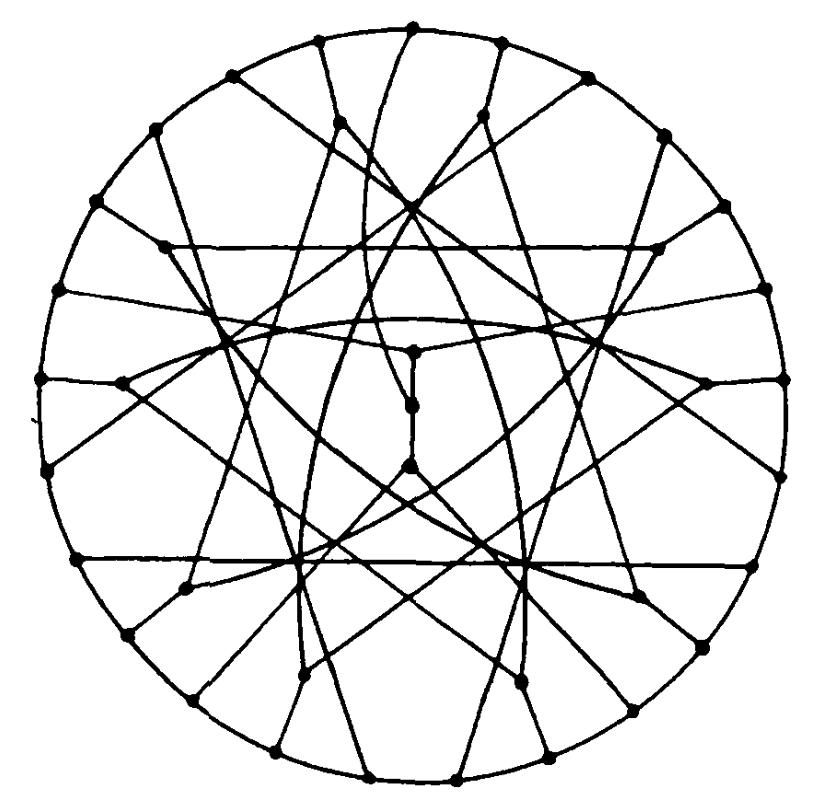
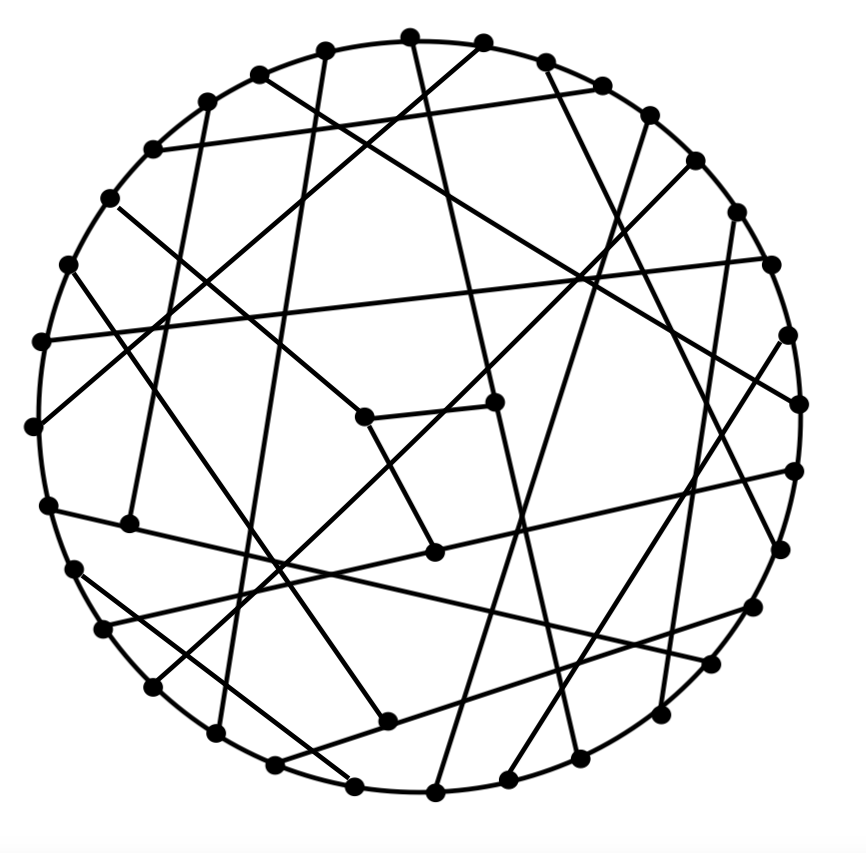 Alegre, Fiol, Yebra, von Conta graph ------- Doty graph
Described independently in:
- [Do82] K.W. Doty; Large regular interconnection networks;
Proc. 3rd. Int. Conf. on Distributed Computing Systems, IEEE Press, Miami, October 1982, pp. 312-317.
link to the paper (local)
- [vCo83] C. von Conta.
Torus and other networks as communication networks with up to some hundred points.
IEEE Trans Comp,c-32 (1983), pp. 657-666.
- [AlFiYe86] I. Alegre, M.A. Fiol and , J.L.A Yebra.
Some large graphs with given degree and diameter.
J. Graph Theory,10 (1986), pp.219-224.
The proof of optimality appeared in:
Dominique Buset.
Maximal cubic graphs with diameter 4. Discrete Appl. Math.101 (2000) pp. 53--61.
The graph constructed by K.W. Doty is not isomorphic to the other graphs (which are)
Download the adjacency list of the graph AFY in NetworkX format (vertices notation as in AlFiYe86).
Download the adjacency list of the graph AFY in NetworkX format (vertices labeled 0,2,...37). This graph has average distance 3.10811. Automorphism group size: 8.
More information at The House of Graphs.
Download the adjacency list of the Doty graph in NetworkX format (vertices labeled 0,2,...37). This graph has average distance 3.11664. Automorphism group size: 16.
More information at The House of Graphs.
--------------------
This SageMath script computes several properties of the graphs including symmetry group sizes and the number of k-cycles (k=3..10). This is the online version .
Bhakar_104
Degree = 4, Diameter = 4; Order =104; Moore bound=161;
Nishant Bhakar (nishant.bhakar@gmail.com, Redmond, WA, USA; August 27, 2026) found three non-isomorphic graphs with 104 vertices and 208 edges. One of them with a high symmetry.
 The construction is a Z_8-voltage graph lift of a 13-vertex base multigraph with loops and semi-edges, followed by a symmetry-breaking repair obtained through iterative experimentation with different approaches, with Claude Fable assisting with implementation and the analysis and summarization of the results..
** Download the 104c_d4D4.txt edge list of the graph.
** Download the 104b_d4D4.txt edge list of a non-isomorphic graph.
** Download the 104_d4D4.txt edge list edge list of another non-isomorphic graph.
This SageMath script computes several properties of the graph. This is the online version .
The construction is a Z_8-voltage graph lift of a 13-vertex base multigraph with loops and semi-edges, followed by a symmetry-breaking repair obtained through iterative experimentation with different approaches, with Claude Fable assisting with implementation and the analysis and summarization of the results..
** Download the 104c_d4D4.txt edge list of the graph.
** Download the 104b_d4D4.txt edge list of a non-isomorphic graph.
** Download the 104_d4D4.txt edge list edge list of another non-isomorphic graph.
This SageMath script computes several properties of the graph. This is the online version .
Former result, order 100
Graph constructed by Gavin Uberti (gavin.uberti@gmail.com>; August 22, 2026).
It was found as part of his work; 4-regular graphs are useful in semiconductors because that is the maximum number of x16 PHYs that can be placed horizontally on the bottom of a standard 26x33mm reticle.
Download the edge list of the graph.
This SageMath script computes several properties of the graph. This is the online version .
Former result, order 98
Communicated by G. Exoo (May 19, 2010).
G.E. data
Download the implicit adjacency list of the graph.
adjlist NX format
This SageMath script computes several properties of the graphs including symmetry group sizes and the number of k-cycles (k=3..). This is the online version
Rajiv_252
Degree = 5, Diameter= 4; Order=252; Moore bound=426;
Obtained by Rishabh Rajiv (rishabh.rajiv@alumni.ubc.ca, September 24, 2026) with the use of AI agentic coding systems. Orbit graph from G = A7, of order 2520, with orbits V1,V2,V3 of sizes 42,105,105 and stabilizers of orders 60,24,24.
In this link
https://doi.org/10.5281/zenodo.22928337
you can download the edge list, a paper and information detailing the construction of the graph.
Download the local edge list of the graph.
This SageMath script computes several properties of the graph, including symmetry group sizes and the number of k-cycles (k=3..). This is the online version
Former result, order=212
Communicated by Eyal Loz, Math Dep., Auckland Univ., New Zealand (July 2006)
G.E. data
Download the implicit adjacency list of the graph.
adjlist NX format
This SageMath script computes several properties of the graph, including symmetry group sizes and the number of k-cycles (k=3..). This is the online version
Rajiv_441
Degree= 6, Diameter = 4; Order =441; Moore bound=937
Obtained by Rishabh Rajiv (rishabh.rajiv@alumni.ubc.ca, Septembert 24, 2026) with the use of AI agentic coding systems. Orbit graph from G= PSU(3,3), of order 6048, with orbits V1,V2,V3 of sizes 63,189,189
and stabilizers of orders 96,32,32.
In this link
https://doi.org/10.5281/zenodo.22928337
you can download the edge list, a paper and information detailing the construction of the graph.
Download the local edge list of the graph.
This SageMath script computes several properties of the graph, including symmetry group sizes and the number of k-cycles (k=3..). This is the online version
Former result, order=390
Communicated by Eyal Loz, Math Dep., Auckland Univ., New Zealand (July 2006)
Voltage graph Z_15 x(3) Z_13, D(2,2), voltages [(2,8)<>(14,4),(0,0)<>(13,6),(9,4)<>(7,7)], avg. dist.: 3.444730
Z_m x(a) Z_n represents a semidirect product of cyclic groups [x,y][u,v]= [x + u mod m, y*a^u + v mod n].
Download the raw adjacency list of the graph.
adjlist NX format
Link to Eyal Loz's data (internet archive) .
This SageMath script computes several properties of the graph, including symmetry group sizes and the number of k-cycles (k=3..). This is the online version
Michel_684
Degree= 7, Diameter = 4; Order =684; Moore bound=1814
Obtained by Michel de Messieres (michel@demessieres.com, October 5, 2026). The search programs were written and run by an AI assistant (Anthropic's Claude) under the author's direction.
Lift of a voltage graph with two vertices over the semidirect product of cyclic groups Z9 (⋊23) Z38. Each vertex type has four neighbours of its own type and 3 of the other type. The automorphism group is the lifted group, with two orbits, so the graph is not vertex-transitive.
They were found by a computer search over such groups of order just above half the former entry , optimising the voltages by simulated annealing until every pair of vertices was within distance 4.
The graph and a detailed write-up are also on Zenodo https://doi.org/10.5281/zenodo.23167440 Download the edge list of the graph.
This SageMath script computes several properties of the graphs. This is the online version .
Former result, order=672
Obtained as a Cayley graph for semidirect product of Zm with Zn
Z6 (⋊39) Z112 [2,73]<>[4,23], [5,54]<>[1,22], [5,71]<>[1,31], [3,42] avg.dist 3.496274
M. Sampels.
Large networks with small diameter.. In: Rolf H. Mohring (Ed.):
23rd International Workshop on Graph-Theoretic Concepts in Computer Science (WG '97), Lecture Notes in Computer Science 1335, pp. 288-302, Springer-Verlag, 1997 ISBN 3-540-63757-5. Communicated July 29, 1997
Download the raw adjacency list of the graph in NetworkX format (vertices labeled 0,2,...671) .
Other instances (F.Comellas 2024)
Z6 (⋊23) Z112 [2,95]<>[4,97], [1,77]<>[5,21], [5,36]<>[1,68], [3,56] Avg.dist 3.496274 transm. 2346 adjlist NX
Z6 (⋊23) Z112 [1,102]<>[5,54], [2,51]<>[4,45], [5,83]<>[1,107], [3,42] Avg.dist 3.496274 transm. 2346 adjlist NX
Z6 (⋊23) Z112 [4,101]<>[2,107], [5,64]<>[1,96], [5,101]<>[1,29], [3,84] Avg.dist 3.496274 transm. 2346 adjlist NX
Z6 (⋊23) Z112 [2,65]<>[4,31], [1,22]<>[5,38], [5,85]<>[1,61], [3,98] Avg.dist 3.496274 transm. 2346 adjlist NX
Z6 (⋊39) Z112 [2,23]<>[4,41], [1,0]<>[5,0], [1,103]<>[5,95], [3,28] Avg.dist 3.496274 transm. 2346 adjlist NX
Z6 (⋊39) Z112 [2,5]<>[4,43], [5,73]<>[1,65], [1,28]<>[5,28], [3,0] Avg.dist 3.496274 transm. 2346 adjlist NX
Z6 (⋊39) Z112 [4,57]<>[2,103], [5,30]<>[1,62], [1,101]<>[5,29], [3,42] Avg.dist 3.496274 transm. 2346 adjlist NX
Z6 (⋊39) Z112 [5,48]<>[1,32], [2,9]<>[4,55], [5,33]<>[1,57], [3,84] Avg.dist 3.496274 transm. 2346 adjlist NX
--------------------
This SageMath script computes several properties of two of the graphs including symmetry group sizes. This is the online version .
Loz_1100
Degree= 8, Diameter = 4; Order =1100; Moore bound=3201
Communicated by Eyal Loz, Math Dep., Auckland Univ., New Zealand (July 2006)
Voltage graph Z20 (⋊2) Z55, B(0,4), voltages [(4, 27)(12, 11)(9,9)(19, 11)], avg. dist.: 3.547771
Zm (⋊a) Zn represents a semidirect product of cyclic groups [x,y][u,v]= [x + u mod m, y*a^u + v mod n].
Download the raw adjacency list of the graph.
Link to Eyal Loz's data (internet archive) .
Found also as a Cayley graph semidirect product, some instances have a lower average distance (F.Comellas 2023):
Z20 (⋊2) Z55 with generators [1,45]<>[19,5]:[12,47]<>[8,13]:[11,39]<>[9,52]:[16,26]<>[4,24]. Avg. dist. 3.547771 (1,8,56,361,674) trans.: 3899 adjlist NX
Z20 (⋊3) Z55 with generators [9,8]<>[11,9]:[1,39]<>[19,42]:[8,1]<>[12,24]:[12,22]<>[8,33]. Avg. dist. 3.536852 (1,8,56,373,662) trans.: 3887 adjlist NX
Z20 (⋊3) Z55 with generators [1,33]<>[19,44]:[8,13]<>[12,37]:[9,2]<>[11,16]:[12,44]<>[8,11]. Avg. dist. 3.536852 (1,8,56,373,662) trans.: 3887 adjlist NX
Z20 (⋊8) Z55with generators [16 9]<>[4 41]:[7 10]<>[13 50]:[17 12]<>[3 16]:[12 8]<>[8 37]. Avg. dist. 3.547771 adjlist NX
Z20 (⋊8) Z55 with generators [12,54]<>[8,16]:[16,2]<>[4,3]:[13,16]<>[7,23]:[17,37]<>[3,31]. Avg. dist. 3.547771 adjlist NX
Z20 (⋊38) Z55with generators [7,18]<>[13,16]:[16,54]<>[4,31]:[3,35]<>[17,5]:[4,48]<>[16,2]. Avg. dist. 3.536852 (1,8,56,373,662) trans.: 3887 adjlist NX
Z20 (⋊47) Z55with generators [8,43]<>[12,42]:[11,8]<>[9,34]:[19,17]<>[1,26]:[12,54]<>[8,16]. Avg. dist. 3.536852 (1,8,56,373,662) trans.: 3887 adjlist NX
Z20 (⋊48) Z55with generators [11,5]<>[9,40]:[19,16]<>[1,2]:[12,3]<>[8,17]:[8,11]<>[12,44]. Avg. dist. 3.536852 (1,8,56,373,662) trans.: 3887 adjlist NX
--------------------
This SageMath script computes several properties of two of the graphs including symmetry group sizes. This is the online version .
Com_1640
Degree= 9, Diameter = 4; Order =1640; Moore bound=5266.
Cayley graph. Found as a semidirect product, 1640 nodes and 7380 (F.Comellas 2024):
- Z40 (⋊22) Z41, generators [23,14]<>[17,33]:[25,18]<>[15,13]:[27,35]<>[13,33]:[2,23]<>[38,8]:[20,3]<>[20,3]. Avg. dist.: 3.571080 (1,9,72,532,1026) transmission: 5853. adjlist NX
Z40 (⋊24) Z41,, generators [25,28 ]<>[15,2 ]:[14,40 ]<>[26,33 ]:[29,11 ]<>[11,39 ]:[39,12 ]<>[1,40 ]:[20,35 ]<>[20,35 ]. Avg. dist.: 3.571080 (1,9,72,532,1026) transmission: 5853. adjlist NX
The two graphs are isomorphic.
--------------------
This SageMath script computes several properties of the graphs including symmetry group sizes. This is the online version .
--------------------
Former result, Order =1550
Communicated by Eyal Loz, Math Dep., Auckland Univ., New Zealand (July 2006)
Voltage graph Z_10 x(4) Z_155, B(1,4), voltages [(5, 0)|(7, 1)(4, 52)(6, 136)(1, 72)], avg. dist.: 3.555197
Z_m x(a) Z_n represents a semidirect product of cyclic groups [x,y][u,v]= [x + u mod m, y*a^u + v mod n].
Download the raw adjacency list of the graph.
Link to Eyal Loz's data (internet archive)
Found also as a semidirect product (F.Comellas 2023):
Z_10 x(4) Z_155 with generators [9,55]<>[1,90]:[6,126]<>[4,139]:[3,98]<>[7,13]:[6,142]<>[4,73]:[5,31]. Avg. dist. 3.555197 adjlist NX
Z_10 x(39) Z_155; generators [6,79]<>[45,6]:[9,1]<>[1,116]:[6,57]<>[4,113]:[3,130]<>[7,50]:[5,124]. Avg. dist. 3.555197 adjlist NX
Z_10 x(64) Z_155 with generators[9,132]<>[1,77]:[8,153]<>[2,132]:[7,19]<>[3,34]:[2,71]<>[8,114]:[5,0]. Avg. dist. 3.555197 adjlist NX
Dahr_2485
Degree= 10, Diameter = 4; Order =2485; Moore bound=8201.
Dharunish Yugeswardeenoo (dharyugi@gmail.com; August 17,2026). Results obtained by using a hybrid discovery framework in development: LLM-guided search over classical algebraic constructions, combined with local search and exact completion. The specific LLMs used were OpenAI's Sol 5.6 and Anthropic's Claude Fable 5 Max.
Cayley graph Z35 (⋊2) Z71 , generators: (18,57)<>(17,13), (12,66)<>(23,3), (29,12)<>(6,13), (33,22)<>(2,54), (14,27)<>(21,35). Avg. dist.: 3.619968. Dist. distrib . [1, 10, 90,734, 1650]
Download the raw adjacency list .
This SageMath script computes several properties of the graphs including symmetry group sizes and the number of k-cycles (k=3..). This is the online version .
Former result, order=2331
(10,4)=2331. Cayley graphs. Found as semidirect products, 2331 vertices, 11655 edges (F.Comellas 2024):
Z9 (⋊44) Z259 , generators [8,132] [2,171] [2,71] [4,236] [6,240]. Avg. dist.: 3.580258 (1,10,90,768,1462) transmission: 8342. adjlist NX
This SageMath script computes several properties of the four graphs including symmetry group sizes. This is the online version .
Dhar_3444
Degree = 11, Diameter = 4; Order = 3444; Moore bound=12222.
Dharunish Yugeswardeenoo (dharyugi@gmail.com; Chalfont, PA, USA; October 7, 2026). Results obtained by using a hybrid discovery framework in development: LLM-guided search over classical algebraic constructions, combined with local search and exact completion. The specific LLMs used were OpenAI's Sol 5.6 and Anthropic's Claude Fable 5 Max.
Incidence graph of the symplectic generalized quadrangle W(9) (820 points, 820 lines, 10-regular, diameter 4, girth 8), doubled: every vertex gets two copies and a base edge a-b carrying a voltage x in {0,1} joins (a,i) to (b,i+x). The voltages are chosen (by local search) so that for each of the 597,780 pairs of opposite vertices the 10 geodesics between them do not
all have the same voltage sum; both copies of the far vertex are then reached in 4 steps. The two copies of every line are joined to each other, which settles all pairs at base distance less than 4 and leaves each of the 1,640 point-copies one free slot. Those slots carry 164 twin vertices: for each of the 82 lines of a spread and each of the two sheets, a new vertex joined to the 10 point-copies adjacent to that copy of the line; the two twins of a spread line are adjacent. 3,280 + 164 = 3,444 vertices, 11-regular, diameter 4.
Download the raw adjacency list of the graph.
This SageMath script computes several properties of the graphs including symmetry group sizes and the number of k-cycles (k=3..). This is the online version .
Former result, order=3235
Q7(T4)+ Dharunish Yugeswardeenoo (dharyugi@gmail.com; Sept. 14, 2026). Results obtained by using a hybrid discovery framework in development: LLM-guided search over classical algebraic constructions, combined with local search and exact completion. The specific LLMs used were OpenAI's Sol 5.6 and Anthropic's Claude Fable 5 Max.
Obtained from the P. Isufi's 3,220-vertex graph Q7(T4)+ (below): two of its vertices and 47 other edges are deleted, 10 new edges are added between original vertices, and 17 new vertices are added, joined to original vertices (172 edges) and to each other (7 edges). Degree histogram:
Download the raw adjacency list of the graph.
This SageMath script computes several properties of the graphs including symmetry group sizes and the number of k-cycles (k=3..). This is the online version .
Former result, order=3220
Graph constructed with the help of AI tools by Petrit Isufi (isufi.petrit@proton.me; Wuppertal, Germany. August 17, 2026).
After constructing Q7(T4) based on the published details (see below), as the graph is regular, no new vertices can be added without increasing the degrees. Edges are deleted and each deletion is accepted only after an exact re-check that the diameter is still 4, then new vertices are added one at a time by exact CP-SAT, each joined only to freed vertices, none joined to each other. After 215 deletions and 20 new vertices, the final graph has 3220 nodes and 17605 edges, maximum degree 11, and diameter 4, average degree 10.935, degree histogram [0, 0, 0, 0, 0, 0, 0, 0, 0, 0, 210, 3010] and avg. dist.: 3.662781.
Download the edge list of the graph.
This SageMath script computes several properties of the graph. This is the online version .
Former result,, order=3202
Dharunish Yugeswardeenoo (dharyugi@gmail.com; August 17, 2026). Addition of two vertices to the graph below. Results obtained by using a hybrid discovery framework in development: LLM-guided search over classical algebraic constructions, combined with local search and exact completion. The specific LLMs used were OpenAI's Sol 5.6 and Anthropic's Claude Fable 5 Max.
Download the raw adjacency list .
Former result, order=3200
Q7(T4) J. Gomez, M.A. Fiol. Dense Compound Graphs.Ars Combinatoria, 20-A (1985), pp. 211-237. link to the paper
Download the edges list of the graph (thanks to Petrit Isufi).
Mizuno_5832
Degree = 12, Diameter = 4; Order=5832; Moore bound= 17569;
Construction discovered by Ryosuke Mizuno (mizuno@aisystemresearch.com, September 25, 2026) through interaction with ChatGPT via its standard web interface. A simple 12-regular route-chart lift graph on V(C) × F43, where C is a 72-vertex simple 4-regular controller. The graph has 34,992 edges and diameter exactly 4. This uses the route-chart lift definition in [arXiv:2606.15860] with a different diameter certificate: nonsingular controllability matrices for selected length-4 walks, pencils of affine hyperplanes, and unions of affine planes establish the upper bound 4
More details in Mizuno's "degree16-diameter3" github folder
Download the local edge list of the graph.
This SageMath script computes several properties of two of the graphs including symmetry group sizes. This is the online version .
Former result, order=5184
Ccmmunicated Sep 18, 2026 (contact: lmonroe@lanl.gov). Graph-lift construction found using agentic tool URSA ( https://lanl.github.io/ursa LA-UR-26-28353) by J. Amarel, N. DeBardeleben, M. Grosskopf, V. Job, E. Lawrence, L. Monroe and R Somasundaram (LANL)
Download the raw adjacency list of the graph.
This SageMath script computes several properties of the graphs including symmetry group sizes and the number of k-cycles (k=3..). This is the online version .
Former result Q′8*X8++, order=4785
Dharunish Yugeswardeenoo (dharyugi@gmail.com; Sept. 14, 2026). Results obtained by using a hybrid discovery framework in development: LLM-guided search over classical algebraic constructions, combined with local search and exact completion. The specific LLMs used were OpenAI's Sol 5.6 and Anthropic's Claude Fable 5 Max.
Obtained from P. Isufi's 4705-vertex graph (former result below): one of its vertices and 378 other edges are deleted, 8 new edges are added between original vertices, and 81 new vertices are added, joined to original vertices (953 edges) and to each other (9 edges). 24 vertices have degree 11.
Degree histogram:
Download the raw adjacency list of the graph.
This SageMath script computes several properties of the graphs including symmetry group sizes and the number of k-cycles (k=3..). This is the online version .
Former result, order=4707
Graph constructed with the help of AI tools by Petrit Isufi (isufi.petrit@proton.me; Wuppertal, Germany. August 27, 2026).
An improvement on the former entry with 4705 graph. That graph has 223 vertices of degree below 12 ("free stubs"), so a search an exact CP-SAT model whether new vertices can be attached to those free slots without
breaking diameter 4 lead to that two could be, giving 4707; a third is infeasible on that pinned choice, which is not a proof that 4708 is impossible. The new graph has | Ord.: 4707 / Size: 28142 / Diam.: 4 / Avg.dist: 3.72432 / Girth: 3 /
Degree histogram : [0, 0, 0, 0, 0, 0, 0, 0, 0, 0, 0, 200, 4507]
Download the edge list of the graph.
This SageMath script computes several properties of the graph. This is the online version .
Former result Q′8*X8+, order 4705.
Graph constructed with the help of AI tools by Petrit Isufi (isufi.petrit@proton.me; Wuppertal, Germany. August 17, 2026).
After constructing Q′8*X8 based on the published details (Delorme's q = 8 polarity quotient, star-multiplied with the X8 factor of Bermond-Delorme-Farhi) a graph with 4680 vertices, 27820 edges, degree distribution 520 x 11 + 4160 x 12, maximum degree 12, diameter 4, is obtained. Then 25 new vertices were added (with no edges between the new vertices; every new edge is incident with a vertex of degree 11 in the former graph) obtaining a new graph with 4705 vertices, 28118 edges, maximum degree 12, and diameter 4. The greedy search method could not add a 26th vertex. The new graph has order.: 4705 / size: 28118 / diam.: 4 / avg.dist: 3.72455 / girth: 3 / degree histogram [0, 0, 0, 0, 0, 0, 0, 0, 0, 0, 1, 222, 4482]
Download the edge list of the graph.
This SageMath script computes several properties of the graph. This is the online version .
Former result, order 4680.
Q′8*X8 with 4680 vertices. Special product of bibartite graphs from C. Delorme.
C. Delorme. Grands graphes de degré et diamètre donnés.Eur. J. Comb. 6 (1985), pp. 291-302. (submitted 1982) link to the paper
Download the edges list of the graph (thanks to Petrit Isufi).
Q9(T4)++
Degree = 13, Diameter = 4; Order= 6615; Moore bound= 24506;
Dharunish Yugeswardeenoo (dharyugi@gmail.com; Chalfont, PA, USA; October 7, 2026). Results obtained by using a hybrid discovery framework in development: LLM-guided search over classical algebraic constructions, combined with local search and exact completion. The specific LLMs used were OpenAI's Sol 5.6 and Anthropic's Claude Fable 5 Max.
4 new vertices are added to the 6,611-vertex (13,4) graph of R. Rajiv: 59 of its edges are deleted and 73 new edges added between original vertices; each new vertex has degree 13 and the new vertices are not adjacent to each other.
Download the raw adjacency list of the graph.
This SageMath script computes several properties of the graphs including symmetry group sizes and the number of k-cycles (k=3..). This is the online version .
Former result, order=6611
Q9(T4)++ Obtained by Rishabh Rajiv (rishabh.rajiv@alumni.ubc.ca, Septembert 30, 2026) with the use of AI agentic coding systems Anthropic's Claude Fable 5.1 and Opus 5.5. Modification of a previous entry.
In this link:
https://doi.org/10.5281/zenodo.23052995 you can download the details and a paper describing the construction of the graph.
This SageMath script computes several properties of the graphs including symmetry group sizes and the number of k-cycles (k=3.). This is the online version .
Former result, order=6600
Q9(T4)+. Dharunish Yugeswardeenoo (dharyugi@gmail.com; Sept. 14, 2026). Results obtained by using a hybrid discovery framework in development: LLM-guided search over classical algebraic constructions, combined with local search and exact completion. The specific LLMs used were OpenAI's Sol 5.6 and Anthropic's Claude Fable 5 Max.
Obtained from P. Isufi's 6,587-vertex graph Q9(T4)+ (below): three of its vertices and 64 other edges are deleted, 25 new edges are added between original vertices, and 16 new vertices are added, joined to original vertices (178 edges) and to each other (15 edges). 168 vertices have degree 12.Degree histogram:
Download the raw adjacency list of the graph.
This SageMath script computes several properties of the graphs including symmetry group sizes and the number of k-cycles (k=3..). This is the online version .
Former result, order=6587
Q9(T4)+. Graph constructed with the help of AI tools by Petrit Isufi(isufi.petrit@proton.me; Wuppertal, Germany. August 17, 2026).
After constructing Q9(T4) based on the published details (see below), as the graph is regular, no new vertices can be added without increasing the degrees. Edges are deleted and each deletion is accepted only after an exact re-check that the diameter is still 4, then new vertices are added one at a time by exact CP-SAT, each joined only to freed vertices, none joined to each other. After 290 deletions and 27 new vertices, the final graph has 6587 nodes and 42701 edges, maximum degree 13, and diameter 4, average degree 12.965 , degree histogram [0, 0, 0, 0, 0, 0, 0, 0, 0, 0, 0, 0, 229, 6358] and avg. dist.: 3.715966.
Download the edge list of the graph.
This SageMath script computes several properties of the graph. This is the online version .
Former result, order=6560
Q9(T4); J. Gomez, M.A. Fiol. Dense Compound Graphs.Ars Combinatoria, 20-A (1985), pp. 211-237. link to the paper
Download the edges list of the graph (thanks to Petrit Isufi).
Q9(T5)+
Degree = 14, Diameter = 4; Order =8303; Moore bound= 33321;
Obtained by Michel de Messieres (michel@demessieres.com, October 3, 2026). The search programs were written and run by an AI assistant (Anthropic's Claude) under the author's direction.
Rajiv's graph has 357 vertices with unused degree (450 unused slots). We kept ALL 57,791 of its edges and added 15 new vertices of degree 14 (190 edges to original vertices, 10 between new vertices) plus 129 new edges between original vertices in their unused slots. This was done in two steps: first 14 new vertices (8302), then 1 more (8303), each time placing the added edges by annealing until every pair of vertices was within distance 4. Vertices 0--8287 are Rajiv's vertices with his original numbering; 8288?8302 are the new ones.
The graph and a detailed write-up are also on Zenodo https://doi.org/10.5281/zenodo.23136968 Download the edge list of the graph.
This SageMath script computes several properties of the graphs. This is the online version .
Former result, order=8208
Obtained by Rishabh Rajiv (rishabh.rajiv@alumni.ubc.ca, Septembert 30, 2026) with the use of AI agentic coding systems Anthropic's Claude Fable 5.1 and Opus 5.5. Modification of a previous entry.
In this link:
https://doi.org/10.5281/zenodo.23052995 you can download the details and a paper describing the construction of the graph.
This SageMath script computes several properties of the graphs including symmetry group sizes and the number of k-cycles (k=3.). This is the online version .
Former result, order=8266
Dharunish Yugeswardeenoo (dharyugi@gmail.com; Sept. 14, 2026). Results obtained by using a hybrid discovery framework in development: LLM-guided search over classical algebraic constructions, combined with local search and exact completion. The specific LLMs used were OpenAI's Sol 5.6 and Anthropic's Claude Fable 5 Max.
Obtained from P. Isufi's 8,255-vertex graph Q9(T5)+ (below): two of its vertices and 89 other edges are deleted, and 13 new vertices are added, joined to original vertices (167 edges) and to each other (5 edges); no edges are added between original vertices. 94 vertices have degree below 14 (120 free slots). Degree histogram:
Download the raw adjacency list of the graph.
This SageMath script computes several properties of the graphs including symmetry group sizes and the number of k-cycles (k=3..). This is the online version .
Former result, order=8255
Graph constructed with the help of AI tools by Petrit Isufi (isufi.petrit@proton.me; Wuppertal, Germany. August 17, 2026).
After constructing Q9(T5) based on the published details (see below), as the graph is regular, no new vertices can be added without increasing the degrees. Edges are deleted and each deletion is accepted only after an exact re-check that the diameter is still 4, then new vertices are added one at a time by exact CP-SAT, each joined only to freed vertices, none joined to each other. After 417 deletions and 55 new vertices, the final graph has 8255 nodes and 57747 edges, maximum degree 14, and diameter 4, average degree 13.99 , degree histogram [0, 0, 0, 0, 0, 0, 0, 0, 0, 0, 0, 0, 2, 72, 8181] and avg. dist.: 3.736110 .
Download the edge list of the graph.
This SageMath script computes several properties of the graph. This is the online version .
Former result, order=8200
Q9(T5); J. Gomez, M.A. Fiol. Dense Compound Graphs.Ars Combinatoria, 20-A (1985), pp. 211-237. link to the paper
Download the edges list of the graph (thanks to Petrit Isufi).
Q11(T4)+
Degree = 15, Diameter = 4; Order =11785; Moore bound = 44326 ;
Dharunish Yugeswardeenoo (dharyugi@gmail.com; Chalfont, PA, USA; October 7, 2026). Results obtained by using a hybrid discovery framework in development: LLM-guided search over classical algebraic constructions, combined with local search and exact completion. The specific LLMs used were OpenAI's Sol 5.6 and Anthropic's Claude Fable 5 Max.
Built on R. Rajiv's (15,4) construction (Zenodo 10.5281/zenodo.23052995): four copies of the incidence graph of the symplectic generalized quadrangle W(11), 2,928 vertices each, joined by index-aligned matchings, with the point-point matchings cut at a partial ovoid of W(11) and the line-line matchings at a line spread. All of his parameters are used unchanged except the point cut set: in place of a 68-point partial ovoid I use one with 72 points, which leaves more free slots. 72 new vertices are then attached, each taking one cut point together with spread lines in two of the blocks -- 9 of them with three lines per block, joined in a 9-cycle, and 63 with two lines per block and a 4-regular graph among themselves -- and one further vertex uses no cut point at all. 4 x 2,928 + 73 = 11,785 vertices, maximum degree 15, diameter 4. The 72 points of the partial ovoid are listed here: 1043 1093 1284 300 1035 905 837 736 957 1438 938 1157 417 1274 1193 149 1352 154 1414 292 1263 742 104 1132 125 1031 1219 236 1156 1330 241 536 733 929 985 1070 925 279 96 97 757 1023 160 766 750 821 523 1442 1019 718 1096 63 105 1228 225 1173 571 939 1138 1452 962 135 443 312 446 1029 433 801 252 201 695 857
Download the raw adjacency list of the graph.
Former result, order=11780
Q11(T4)+ Obtained by Rishabh Rajiv (rishabh.rajiv@alumni.ubc.ca, Septembert 30, 2026) with the use of AI agentic coding systems Anthropic's Claude Fable 5.1 and Opus 5.5. Modification of a previous entry.
In this link:
https://doi.org/10.5281/zenodo.23052995 you can download the details and a paper describing the construction of the graph.
This SageMath script computes several properties of the graphs including symmetry group sizes and the number of k-cycles (k=3.). This is the online version .
Former result, order=11759
Dharunish Yugeswardeenoo (dharyugi@gmail.com; Sept. 14, 2026). Results obtained by using a hybrid discovery framework in development: LLM-guided search over classical algebraic constructions, combined with local search and exact completion. The specific LLMs used were OpenAI's Sol 5.6 and Anthropic's Claude Fable 5 Max.
Obtained from P. Isufi's 11736-vertex graph Q11(T4)+ (below): eight of its vertices and 59 other edges are deleted, 13 new edges are added between original vertices, and 31 new vertices are added, joined to original vertices (374 edges) and to each other (43 edges). 251 vertices have degree 14. Degree histogram:
Download the raw adjacency list of the graph.
This SageMath script computes several properties of the graphs including symmetry group sizes and the number of k-cycles (k=3..). This is the online version .
Former result, order=11736
Graph constructed with the help of AI tools by Petrit Isufi (isufi.petrit@proton.me; Wuppertal, Germany. August 19, 2026).
After constructing Q11(T4) based on the published details (see below), as the graph is regular, no new vertices can be added without increasing the degrees. Edges are deleted and each deletion is accepted only after an exact re-check that the diameter is still 4, then new vertices are added one at a time by exact CP-SAT, each joined only to freed vertices, none joined to each other. After 382 deletions and 24 new vertices, the final graph has 11736 nodes and 87814 edges, maximum degree 15, and diameter 4, average degree 14.965 , degree histogram [0, 0, 0, 0, 0, 0, 0, 0, 0, 0, 0, 0, 0, 1, 410, 11325] and avg. dist.: 3.748630 .
Download the edge list of the graph.
Former result
(15,4)=11712. Q11(T4); J. Gomez, M.A. Fiol. Dense Compound Graphs.Ars Combinatoria, 20-A (1985), pp. 211-237. link to the paper
URSA_16384
Degree = 16, Diameter = 4; Order =16384; Moore bound=57857
Ccmmunicated Sep 18, 2026 (contact: lmonroe@lanl.gov). Graph-lift construction found using the agentic tool URSA ( https://lanl.github.io/ursa LA-UR-26-28353) by J. Amarel, N. DeBardeleben, M. Grosskopf, V. Job, E. Lawrence, L. Monroe and R Somasundaram (LANL)
Download the raw adjacency list of the graph.
This SageMath script computes several properties of the graphs including symmetry group sizes and the number of k-cycles (k=3..). This is the online version (it may not run correctly as the graph is large).
Former result Q11(T5)+, order=14707
Dharunish Yugeswardeenoo (dharyugi@gmail.com; Sept. 14, 2026). Results obtained by using a hybrid discovery framework in development: LLM-guided search over classical algebraic constructions, combined with local search and exact completion. The specific LLMs used were OpenAI's Sol 5.6 and Anthropic's Claude Fable 5 Max.
Obtained from P. Isufi's 14687-vertex graph Q11(T5)+ (below): five of its vertices and 136 other edges are deleted, and 25 new vertices are added, joined to original vertices (339 edges) and to each other (21 edges); no edges are added between original vertices. 75 vertices have degree below 16 (122 free slots). Degree histogram:
Download the raw adjacency list of the graph.
This SageMath script computes several properties of the graphs including symmetry group sizes and the number of k-cycles (k=3..). This is the online version .
Former result, order=14687
Graph constructed with the help of AI tools by Petrit Isufi (isufi.petrit@proton.me; Wuppertal, Germany. August 19, 2026).
After constructing Q11(T5) based on the published details (see below), as the graph is regular, no new vertices can be added without increasing the degrees. Edges are deleted and each deletion is accepted only after an exact re-check that the diameter is still 4, then new vertices are added one at a time by exact CP-SAT, each joined only to freed vertices, none joined to each other. After 400 deletions and 47 new vertices, the final graph has 14687 nodes and 117451 edges, maximum degree 16, and diameter 4, average degree 15.994, degree histogram [0, 0, 0, 0, 0, 0, 0, 0, 0, 0, 0, 1, 0, 0, 5, 75, 14606] and avg. dist.: 3.770451.
Download the edge list of the graph.
Former result
(16,4)=14640. Q11(T5); J. Gomez, M.A. Fiol. Dense Compound Graphs.Ars Combinatoria, 20-A (1985), pp. 211-237. link to the paper